Press kit
Downloadable assets for citation, reposting, podcast appearances, media coverage, and research references.
This page contains the canonical public press materials for Next Generation Stores of Value: Privacy, Proofs, Compute.
Included assets
- Thesis cover image, logo mark, and wordmark
- Short, medium, and long author bios
- Approved project descriptions (50w / 100w / 200w)
- Essay-grade pull quotes (12 from the essay, 5 retained from the thesis)
- "10 takeaways" pre-written media distillation
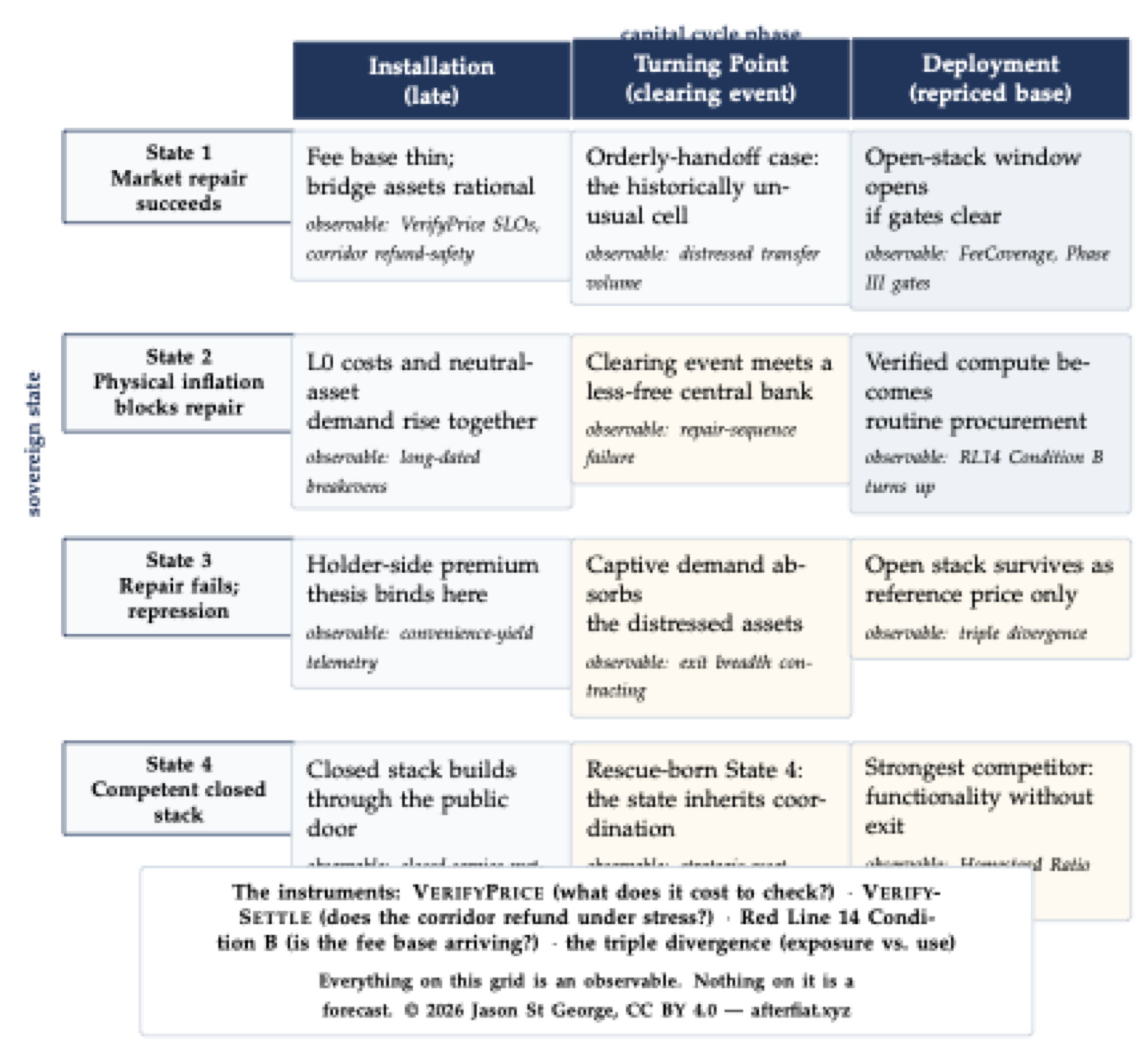
- Figure pack (web + print) including the state-grid figure
- Thesis metadata and citation guidance
- Canonical 525-page v3.2 PDF and the standalone essay (v1.3)
- Operator & investor checklist (2-page standalone extraction)
The essay and the instruments
The standalone essay (12 pp., CC BY 4.0) is the front door: the instrument-panel framing for the monetary regime transition, with no subordination to the full record. The instruments are public goods — useful whether or not the thesis survives.
The grid — four sovereign states against the capital cycle, every cell naming its observable — is the essay's one chart: download (PNG).
Visual identity
Thesis cover image

A faceted crystalline solid with seven layered strata and copper verification paths. Represents the thesis architecture as a dense, verifiable object.
Logo mark

Nested hexagonal rings with a diagonal verification path. Seven layers, monochrome. Functions as favicon, social avatar, and identity element.
Styled wordmark

Split-weight typographic mark: AFTER in regular weight, FIAT in bold. Subtitle: Next Generation Stores of Value.
Approved project descriptions
50-word version
Next Generation Stores of Value: Privacy, Proofs, Compute is a conditional thesis testing whether a bearer base asset may accrue monetary premium by preserving stress-deliverable digital services when substitutes weaken. Its ten premises, nine-link chain, and eighteen red lines require non-bypassability, a persistent self-custodied holder base, and separate infrastructure credit.
100-word version
Under sustained repression, a bearer base asset may accrue monetary premium if holding it preserves private settlement, portable proof, and verified compute after ordinary substitutes weaken. The full service path must remain stress-deliverable; demand must not bypass the asset; a persistent, self-custodied, loss-bearing holder base must absorb residual risk; and infrastructure credit must remain separate. Fees, burns, and collateral explain value capture, not moneyness. Privacy, Proofs, and Compute may share an asset, but whether they should is empirical. Ten premises, nine links, eighteen red lines, and public telemetry keep the claim conditional and falsifiable.
200-word version
The thesis tests a narrower claim: under sustained administrative and financial repression, a bearer base asset may accrue monetary premium if holding it preserves private settlement, portable proof, and verified compute after ordinary legal, custodial, and platform substitutes weaken. Gross capacity is insufficient. The complete path from energy and hardware to usable, settled holder service must remain stress-deliverable, and equivalent services must not bypass the asset.
Moneyness is holder-side: a persistent, self-custodied, loss-bearing constituency must warehouse risk through stress. Fees, burns, collateral, and issuance discipline can explain value capture but do not establish that anchor. Duration-bearing infrastructure credit remains explicit and separate. Privacy, Proofs, and Compute may share an asset, but whether they should is empirical. The public argument uses ten premises, a nine-link chain, and eighteen red lines. The base asset is only a conditional monetary candidate; Work Credits are typed service claims, receipts are evidence, project notes are credit, and LP or staking positions are derivatives or operating claims.
Author bios
Short bio
Jason St George is a writer and researcher working at the intersection of philosophy, money, cryptography, AI, and civilizational systems. He publishes Eschatology Report and is the author of Next Generation Stores of Value: Privacy, Proofs, Compute.
Medium bio
Jason St George is a writer, researcher, and systems thinker whose work explores how truth, agency, and value shift under accelerating technological and institutional change. His writing ranges from existential philosophy and cultural analysis to verification systems, cryptographic infrastructure, and digital service capacities for the AI era. He publishes Eschatology Report and is the author of Next Generation Stores of Value: Privacy, Proofs, Compute.
Long bio
Jason St George is a writer, researcher, and systems thinker working at the intersection of philosophy, money, cryptography, AI, and civilizational systems. His work focuses on the conditions under which truth, agency, and value remain durable when legacy institutions, soft guarantees, and inherited media defaults begin to fail. He publishes Eschatology Report, a long-form publication on philosophy, AI, verification, culture, and modernity, and is the author of Next Generation Stores of Value: Privacy, Proofs, Compute, a versioned thesis testing whether privacy-preserving settlement, portable proofs, and verified compute can support a conditional monetary candidate.
Pull quotes
From the essay (full set of 17 in the kit's pull-quotes.txt):
- "There are two sets of numbers on every serious desk right now. Each set has its own audience, and almost nobody reads both, because each audience is professionally rewarded for ignoring the other."
- "Money is usually discussed as an asset class. This essay discusses it as a sovereign capacity."
- "When checking costs the same as producing, you have a priesthood with extra steps."
- "These are not predictions. They are trip wires. A trip wire does not tell you when the intruder arrives; it tells you, forever after, whether you were watching."
- "A thesis that cannot be killed is a press release."
- "The instruments are the thesis. Everything else is commentary."
Media & appearances
For interviews, citations, media requests, podcast appearances, or figure permissions beyond the CC license, contact: stgeorgejas@gmail.com